
Jan's work
Behavioural research in sharks
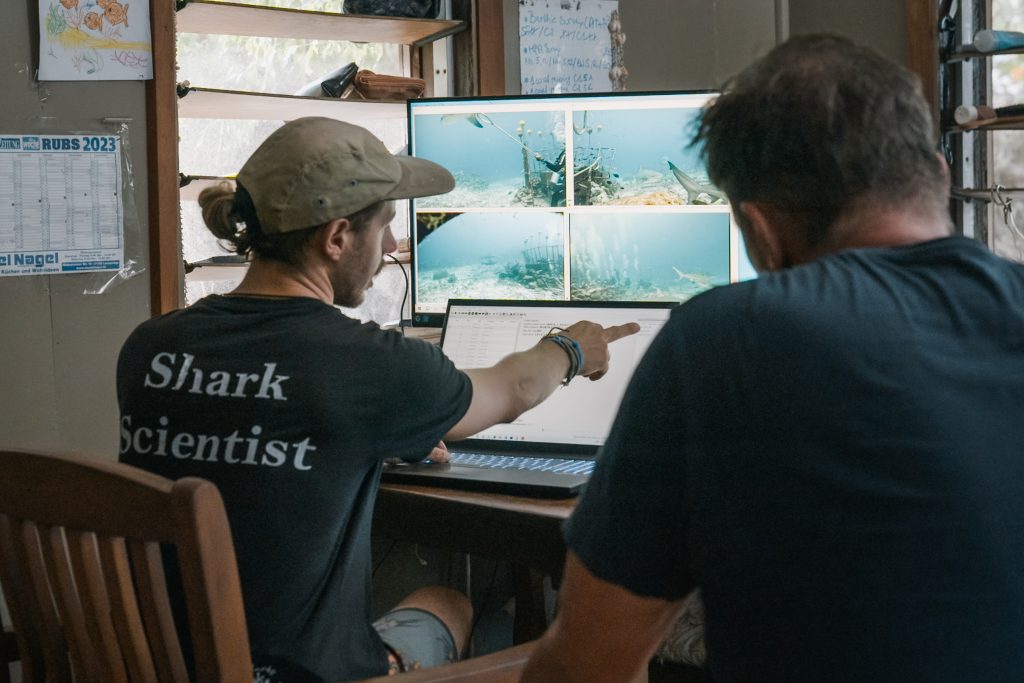
Jan has become an expert in shark behaviour and human–shark interactions. His expertise was built not only from a theoretical perspective, but through hundreds of hours of live observation and fieldwork. Having worked at the frontier between science and ecotourism for several years, he understands both the challenges and the opportunities it offers.
Why study behaviour?
Most studies in sharks focus on the population level, few on the individual itself. Yet, this matters because individuality is not a curiosity at the margins of ecology. Consistent behavioural differences within a species shape how animals feed, compete and reproduce, and greater behavioural diversity within a population is expected to make that population more resilient. In a predator, personality also shapes how it interacts with everything else in its environment, including us.
If you have dived with sharks, you may have noticed differences in behaviour between individuals. Even inexperienced divers notice that some individuals hang back while others come in close for a good look at you. We often quickly assign this phenomenon to the individual: they must have different personalities.
Yet, the truth is much more complicated than this. Behaviour is influenced by various factors, some that are measurable, others not. Therefore, we cannot jump to such a quick conclusion.
To count as personality, those differences have to be consistent over time. Until now, almost everything we knew about shark personality came from juveniles or captive animals, studied over short periods and in small numbers. Whether large, free-ranging adults maintain stable behavioural profiles over years was an open question.
What I did in my PhD
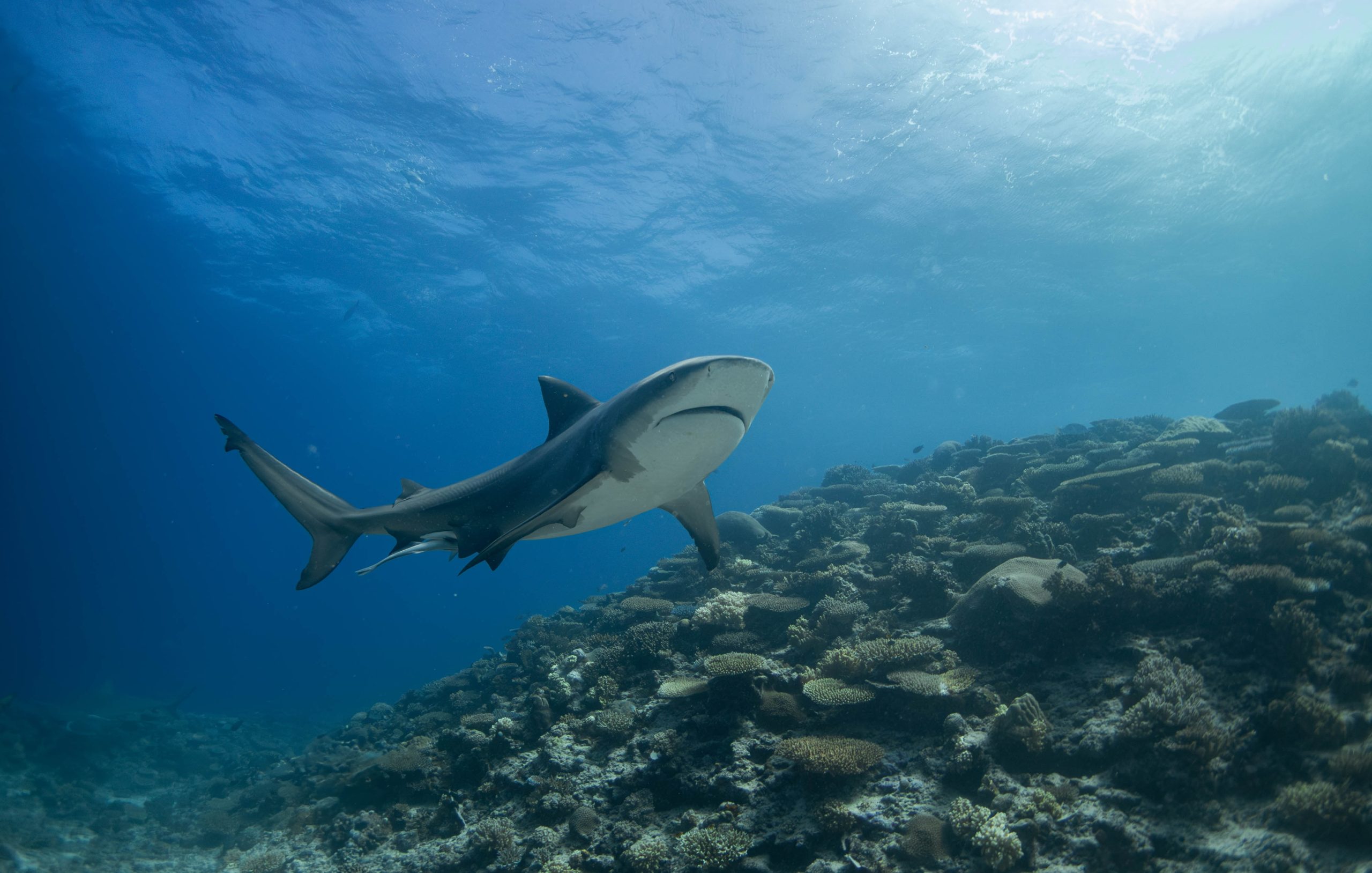
In collaboration with the Barefoot Kuata Island Resort in Fiji, we gained access to a population of catalogued adult bull sharks that regularly visit a shark diving site in the Yasawa Islands.
Through years of field work and video observation, we were able to quantify individual behaviour. This allowed us to analyse whether or not individual behaviour was stable over time and also different between individuals. Most importantly, we could also analyse potential drivers of this variation: to which extent was it context-driven (e.g., through the provisioning), environmentally driven (e.g., changing seasons, number of conspecifics) and intrinsic-driven (e.g., through stable personalities).
What we found
The differences between individual bull sharks turned out to be remarkably stable. After accounting for environment and context, identity alone explained around 40% to 46% of the behavioural variation in our measured behaviours. It was not driven by the weather, by how familiar an animal was with the site, or by how much it had been fed.
The more interesting result was the second layer. Sharks differed not only in how “bold” they were on average, but in how much their behaviour shifted with the seasons. Bolder individuals were generally the more variable ones. Consistency and flexibility, in other words, coexist: an animal can hold a stable rank relative to its peers while still adjusting how strongly it expresses that tendency as conditions change.
This is the first demonstration of long-term personality differences in wild adult sharks. Because the differences persisted even after accounting for each animal’s exposure to the site and its feeding history, they are unlikely to be an artefact of the dive itself, which suggests they exist in natural contexts too.
The work sits alongside two other strands of Jan’s PhD-thesis: a global review of what science has gained from shark-diving sites, and the development of minimally invasive sampling methods that collect genetic material from these animals without catching them, opening the door to asking how much of this individuality is inherited.
Below a list of publications that Jan has contributed to on this topic. If you would like access to one of the publications, please send a request through our contact form or check out our blog posts where we have highlighted some of these publications.
- Séguigne et al., 2023. Evidence of long-lasting memory of a free-ranging top marine predator, the bull shark Carcharhinus leucas. Behaviour
- Vignaud et al., 2023. Examining individual behavioural variation in wild adult bull sharks (Carcharhinus leucas) suggests divergent personalities. Behaviour
- Bierwirth et al., 2025. Opportunities for science in touristic shark feeding aggregations – A review. Global Ecology and Conservation
SHARKPROJECT International
SHARKPROJECT is an internationally recognized association dedicated to the protection of sharks through direct action campaigns, support of promising conservation and research projects, education and political lobbying.
Since 2023, Jan has been board member overseeing supported projects & advocacy work. In 2025, he was part of the team that initiated the transformation of the organization.
Together with the other board members, he is now leading the transformation of the organisation and the founding of the Stiftung SHARKPROJECT (a Swiss-registered foundation dedicated to shark conservation).
In the past SHARKPROJECT has acted fully on voluntary basis. Despite all conservation efforts, shark’s keep on struggling and the threats keep increasing. Hence why he has been at the forefront of professionalizing the organization with the goal of establishing a full-time team working in the field of political advocacy and fisheries management and supporting local conservation projects.
Advice & Impact
Jan especially advises on long-term scientific and conservation strategy and oversees its implementation across projects and campaigns. Through his expertise he makes sure activities are designed around the impact they are meant to deliver and evaluated against it.
Support
You want to contribute to meaningful shark conservation? Donate here and help protect sharks!
credits: Kevin Peyrusse